
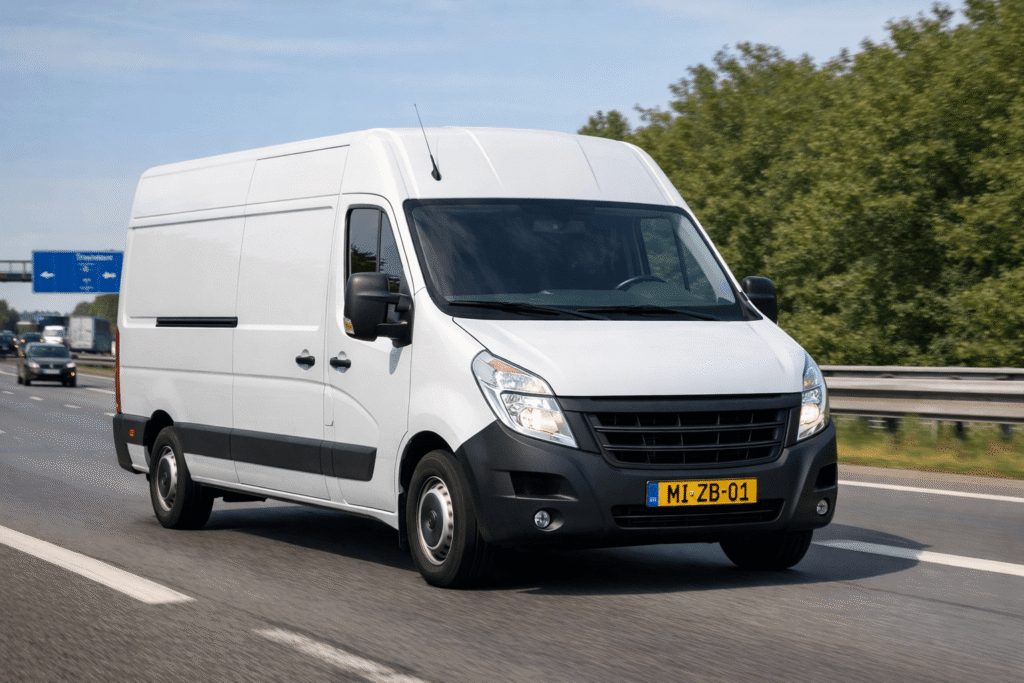
From 1 July 2026, European legislation for commercial vehicles will change. The tachograph requirement will be extended to vehicles from 2,500 kg that transport goods internationally. This means many companies operating vans across borders will soon be required to use a Smart Tachograph 2.
For entrepreneurs in transport, service, and logistics, this legislative change can have significant consequences. Not only must a tachograph be installed in the vehicle, but companies also need to record driving and rest times and regularly download and store tachograph data.
In this blog, we explain what the new rules mean, which vehicles they apply to, and how you can easily meet the obligations.
Contents:
- What changes with the tachograph requirement from 2,500 kg?
- Ever-changing legislation
- Previous situation: tachograph required from 3,500 kg
- From 2026: tachograph requirement for vans from 2,500 kg
- When does the tachograph requirement apply to your van?
- Downloading and storing tachograph data
- Automatic tachograph download with Moving Intelligence
- What is Smart Tachograph 2 or Tacho 2.0?
- Does your commercial vehicle need a tachograph?
- Frequently asked questions
- Does the tachograph requirement also apply to campers over 2,500 kg?
From 1 July 2026 for vehicles over 2,500 kg
What changes with the tachograph requirement from 2,500 kg?
From 1 July 2026, commercial vehicles from 2,500 kg that transport goods internationally will be required to use a tachograph.
The main changes:
- Tachograph requirement for vehicles between 2,500 and 3,500 kg
- Mandatory use of Smart Tachograph 2
- Recording of driving and rest times
- Mandatory downloading and storage of tachograph data
These rules apply to companies carrying out international transport with vans or light commercial vehicles (LCV).

Moving Intelligence helps
Ever-changing legislation
The regulations surrounding tachographs change regularly and can be complex for companies with a fleet. Moving Intelligence helps organizations daily with trip registration, vehicle data, and tachograph management. Our solutions are used in hundreds of thousands of vehicles across Europe. This allows us to see in practice the challenges companies face with:
- Tachograph downloads
- Recording of driving and rest times
- Fleet management
- Compliance with European transport regulations
Based on this practical experience, we explain below what the new tachograph rules mean for vans.
“Unfair” competition
Previous situation: tachograph required from 3,500 kg
Until now, the tachograph requirement mainly applied to trucks and heavier commercial vehicles. In most cases, vehicles only needed a tachograph when the maximum permissible mass (the total weight of a vehicle including the driver, fuel, and maximum load) exceeded 3,500 kilograms. Many vans, which typically have a maximum permissible mass of 3,500 kilograms, therefore fell outside the European rules for driving and rest times. Companies could carry out international transport with lighter vehicles without a tachograph. This created differences between transport companies using trucks and businesses transporting goods internationally with vans.
New regulations
From 2026: tachograph requirement for vans from 2,500 kg
With the EU Mobility Package the European Union aims to create fair competition and improve road safety. For this reason, the tachograph requirement is being extended to lighter vehicles.
From 1 July 2026, the following rules will apply:
- Vehicles from 2,500 kg to 3,500 kg must have a tachograph
- This applies when the vehicle transports goods internationally
- The tachograph must be a Smart Tachograph 2 (SMT2)
- Drivers must use a driver card
- Companies must download and store tachograph data
This means that many vans and light commercial vehicles will also be subject to the European driving and rest time regulations.
Practical impact
When does the tachograph requirement apply to your van?
The new rules do not apply to every commercial vehicle. It is therefore important to consider the vehicle’s weight, usage, and type of transport.
The tachograph requirement generally applies when:
- the vehicle weighs more than 2,500 kg
- goods are being transported
- the transport takes place internationally within the EU
- the transport is carried out commercially
Practical examples: - Installation companies traveling to Germany with a van and trailer
- Service companies with vehicles around 2,800 kg
- Courier services performing international transport
- Construction companies transporting materials across borders
Administrative obligation
Downloading and storing tachograph data
In addition to using a tachograph, companies are also subject to administrative obligations.
The main obligations:
- Download driver card data at least every 28 days
- Download tachograph data at least every 90 days
- Keep the data for at least one year
For companies with multiple vehicles, this can quickly become a time-consuming task.

Solution
Automatic tachograph download with Moving Intelligence
To comply with the regulations without additional administrative burden, Moving Intelligence offers a solution for automatic tachograph management: Tacho Download.
With this solution, tachograph data is automatically read and stored.
Voordelen:
- Automatic tachograph data download
- Overview of vehicles and drivers
- Secure data storage
- Reduced risk of errors or missed downloads
Technology
What is Smart Tachograph 2 or Tacho 2.0?
The Smart Tachograph 2 is the latest generation of digital tachographs.
This system automatically records:
- Border crossings
- Location via GNSS
- Driving and rest times
- Vehicle movements
This allows inspection authorities to more easily verify whether transport companies comply with the rules.

Checklist for the regulations
Does your commercial vehicle need a tachograph?
Answer these questions:
- Does the vehicle weigh more than 2,500 kg?
- Are goods being transported?
- Is the transport carried out internationally?
- Is the transport part of the company’s business activities?
If the answer to these questions is yes, the tachograph requirement may apply from 2026.
FAQ's over the new laws
Frequently asked questions
From what weight is a tachograph required?
A tachograph is required for vehicles weighing 2,500 kg or more when used for international transport of goods.
Does the tachograph requirement also apply to vans?
Yes, from 1 July 2026, many vans and light commercial vehicles with a weight of 2,500 kg or more that transport goods internationally will also be subject to the tachograph requirement.
Yes, from 1 July 2026, vans weighing between 2,500 kg and 3,500 kg that carry goods internationally will be required to have a tachograph.
Only if it transports goods internationally and weighs more than 2,500 kg.
What is Smart Tachograph 2?
The latest generation tachograph that automatically records locations, border crossings, and driving and rest times.
When must tachograph data be downloaded?
The driver card must be downloaded at least every 28 days, and the tachograph at least every 90 days.
Who checks the tachograph?
The inspector from the Inspectie Leefomgeving en Transport checks compliance with driving and rest times using a portable computer and a download key.
What happens if you do not comply with the tachograph rules?
Inspection authorities can issue fines or suspend transport operations.
What about campers and motorhomes?
Does the tachograph requirement also apply to campers over 2,500 kg?
Many campers are built on a van chassis and weigh more than 2.5 tons. Does this mean a tachograph must be installed? No – in the vast majority of cases, the tachograph requirement does not apply to campers, even if they weigh more than 2,500 kg.o.
The tachograph rules are intended for commercial transport of goods and passengers. Legally, campers are considered recreational vehicles for private use and therefore generally fall outside the European driving and rest time regulations. This means camper owners usually do not need to install a tachograph, even when traveling across multiple EU countries.
There are, however, a few exceptions. A tachograph may be required when:
- a vehicle is registered not as a camper but as a commercial vehicle
- the vehicle is used for commercial transport or rental
- it is used for business-related passenger transport
In practice, this rarely applies to campers. For most camper owners – even with vehicles over 3,500 kg – the tachograph rules do not apply.
Other rules still apply, such as: - the correct driving license (for example, C1 or C) for heavier campers
- national traffic regulations in different countries
- any toll or environmental rules
For companies using vehicles for transport, it is important to carefully check the vehicle registration and its use. **The tachograph requirement only applies when a vehicle is used for commercial transport.
Moving Intelligence – experts in voertuigdata en fleetmanagement
Moving Intelligence – experts in vehicle data and fleet management. Moving Intelligence develops solutions for vehicle security, trip registration, and fleet management. With thousands of connected vehicles, the company helps organizations gain insights into vehicle usage, safety, and regulatory compliance.